DEEP DIVE
ON Micronized Creatine Monohydrate: The Deep Dive
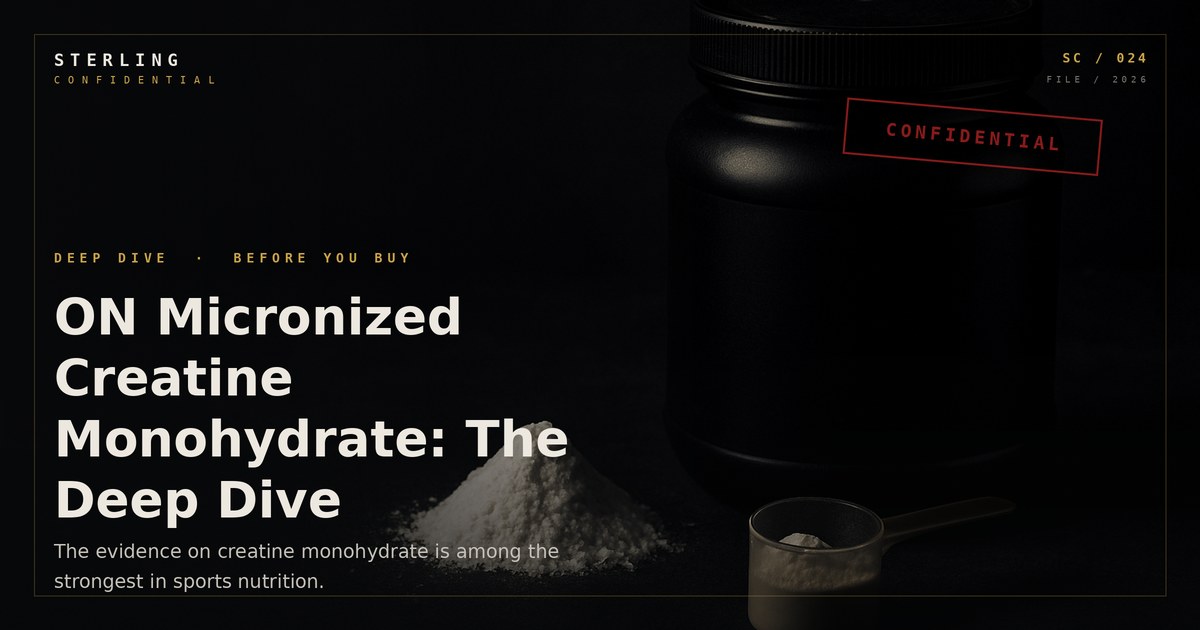
The evidence on creatine monohydrate is among the strongest in sports nutrition. This is the full readout on Optimum Nutrition Micronized Creatine: what it does, who benefits most after 40, how to use it, and why the cheap version beats everything else on the shelf.
Bottom line
Buy this one. Optimum Nutrition Micronized Creatine Monohydrate is plain creatine in Creapure form: the most-studied sports supplement on the market, with a real case for men over 40 on both strength and brain function. Three to five grams a day, taken consistently, is the complete protocol. No loading phase, no cycling, no premium upgrade needed. At roughly fifteen cents per serving, the cost case for skipping it requires a specific reason.
Who this is for
A man over 40 who lifts weights or does any resistance training, and has either been told creatine is worth taking or is wondering whether to start.
Also worth reading if you have dismissed creatine as a young lifter’s supplement. The cognitive and muscle-preservation data in men over 40 is better than most people expect.
Less relevant if you are looking for a comparison between creatine forms. That question has its own answer in our dossier on monohydrate vs HCl.
What it is
A white, unflavored powder. Each serving is 5 grams of micronized creatine monohydrate, no excipients, no added ingredients. Micronized means the particles have been ground finer than standard creatine powder, which improves how well it mixes in water without changing what it does once absorbed.
The Creapure label on the tub is worth noting. Creapure is a trademarked form of creatine monohydrate produced by AlzChem in Germany, with a long track record of purity and consistency testing. ON sources their creatine from this supplier. Not every plain monohydrate tub specifies the source, and many do not.
How it works
Creatine is a compound your body makes from amino acids and stores mainly in muscle. During short, intense effort, a heavy set or a sprint, your muscles burn through a molecule called ATP fast. Creatine phosphate donates a phosphate group to regenerate ATP. More creatine in the muscle means you can sustain that output a little longer before fatigue sets in.
Supplementing creatine raises the concentration of creatine phosphate in your muscle. Most men are not fully saturated from diet alone, especially if they eat little red meat. The supplement fills that gap.
The brain runs on the same energy chemistry. Brain tissue stores creatine too, and the evidence suggests those stores decline with age. More on that below.
The evidence, in depth
Muscle and strength: well established.
The muscle-strength case for creatine is among the strongest in supplement research. The International Society of Sports Nutrition position stand, which reviewed hundreds of trials, rates creatine monohydrate as the most effective nutritional supplement currently available for increasing high-intensity exercise capacity and lean mass during training. That is an unusually firm statement from an academic body. The evidence behind it is wide: multiple trial designs, multiple populations, consistent direction.
For men over 40 specifically, the benefit compounds. Reviews of creatine in older adults find consistent improvements in strength, lean mass, bone mineral density, and functional capacity when combined with resistance training. The effect sizes are real and reproducible. Creatine does not build the muscle for you. It makes the training you do count for more, which is exactly what you need as recovery slows and muscle becomes harder to hold onto. Evidence grade: A.
Cognitive function: promising, not settled.
The cognitive case is newer and less tidy. A 2022 meta-analysis of 22 studies found improvements in memory and intelligence task performance, with effects most consistent in older adults and under cognitive stress, including sleep deprivation and heavy mental load. The mechanism is plausible: brain creatine stores may decline with age, and supplementation may partially restore them.
What the evidence does not yet show: a clean dose-response curve, strong data from well-rested adults doing routine cognitive tasks, or long-term studies in men over 40 as a specific population. The benefit looks real and the direction is consistent, but the magnitude for any individual man is still being worked out.
Treat this as a substantiated bonus, not the primary reason to take it. Evidence grade: B.
Safety: no meaningful concerns in healthy adults.
Creatine monohydrate has been studied for over thirty years. Large safety analyses find no harm to kidney or liver markers in healthy people at standard doses. The kidney-damage concern is a persistent myth, partly because creatine supplementation does raise blood creatinine slightly. That rise is a metabolic artifact from creatine breakdown, not kidney damage. If your GP flags elevated creatinine and you are on creatine, mention it. The result needs context, not a stoppage. Evidence grade: A.
The exception: if you have kidney disease or reduced kidney function, this is a clinician conversation before you start.
Loading: useful but not necessary.
The standard loading protocol (20 grams a day for five to seven days, then 3 to 5 grams daily) reaches full muscle saturation faster. Three to five grams daily with no loading gets to the same endpoint in about four weeks. For a man who has no specific event to prepare for, the no-load approach is simpler and produces the same result. Evidence grade: A.
Timing: a small edge, not worth optimizing.
Post-workout creatine appears marginally better than pre-workout for body composition in the few trials that have tested this directly. The effect size is small. Consistency of daily intake matters far more than when in the day you take it. Take it when you will remember to take it.
What’s inside
Five grams of creatine monohydrate per serving, sourced as Creapure from AlzChem, Germany. Nothing else.
AlzChem has produced Creapure since the 1990s using a controlled synthesis process and batch testing for purity. ON’s product is tested for banned substances through Informed Sport, a third-party certification program. Confirm the current certification status on the Informed Sport website if you are subject to testing in a specific sport.
Micronization is the only processing step beyond the base ingredient. Finer particles dissolve more readily, which means a less gritty texture and faster mixing. The active compound is the same.
Who makes it
Optimum Nutrition was founded in 1986 and is now owned by Glanbia, an Irish nutrition company. It is one of the largest supplement brands in the world. The Gold Standard Whey is the flagship; the creatine uses the same Creapure sourcing and third-party testing approach.
The brand does not bring transparency problems or controversy. The label accurately states what is in the tub. For a commodity ingredient where the sourcing and manufacturing hygiene are the only variables worth assessing, both are documented here.
How it compares
The dossier on creatine monohydrate vs HCl covers the form comparison in full. The short version: a 2025 RCT in trained athletes and a 2023 review found no performance or body-composition advantage for HCl over monohydrate. The pitch for HCl is better absorption, but monohydrate already absorbs at close to 100 percent, leaving little room for an upgrade to matter.
Against other Creapure-sourced monohydrates: the active ingredient is identical. Differences come down to price, serving size, and whether third-party testing is documented. ON Micronized holds its own on all three.
Real-world use
Three to five grams a day, every day, in water or a shake. No loading. No cycling off.
What to expect in the first month: nothing dramatic. Creatine is not a stimulant and you will not feel it working. You may notice slightly better performance on high-effort sets in weeks three to four as muscle stores build up. Some men gain a kilogram or two on the scale early on from water drawn into muscle cells. That is not fat, and most men do not notice it visually.
What to expect from month two onward: the benefit is cumulative. It shows up in the training log over months, in strength numbers and body composition, not in how you feel on day five.
Common mistakes: taking it for two weeks, noticing nothing, and stopping. Taking it only on training days. Starting a loading phase and abandoning it after three days because the volume is annoying. None of these work. Daily consistency is the whole protocol.
Mixing: stir or shake five grams in six to eight ounces of water. Warm water dissolves it faster. A scoop is included in the tub, roughly level five grams.
What it’s worth
One of the better cost-per-outcome cases in the supplement category. At roughly fifteen cents per serving for a large tub, a full year’s supply costs less than most two-month supplement protocols. The evidence quality for the outcome is considerably stronger than most of what sits near it on the shelf.
The premium creatine forms, HCl, buffered, and proprietary blends, often run three to five times the cost per gram with no evidence of advantage. That price difference pays for marketing, not a better result.
Optimum Nutrition Micronized Creatine Monohydrate on Amazon. Prices move; check the current price before buying.
Who should skip
Men with kidney disease or reduced kidney function. Talk to your clinician before starting. The research shows no harm in healthy adults, but a compromised kidney is a different situation and that call belongs to a doctor with your labs in front of them.
Men who will not take it daily. Creatine requires consistency to work. Sporadic use does not build and maintain the muscle saturation the benefit depends on. If daily supplementation is not sustainable, the money is better spent elsewhere.
Men who do no resistance training. The strength and lean-mass benefit requires training to convert the creatine stores into something useful. Creatine amplifies the result of the effort. Without the effort, there is nothing to amplify.
Men currently being worked up for kidney problems. Creatine raises blood creatinine as a metabolic artifact. That can complicate a clinical workup. Wait until the investigation is complete, then discuss with your doctor.
FAQ
Do I need to load? No. Three to five grams daily reaches the same saturation as a loading phase, just four weeks instead of one. Load if you want faster results before a specific event. Otherwise, skip it.
Before or after training? After, based on the few trials that have tested this directly. The difference is small. In practice, consistency beats timing. Take it whenever you will actually remember every day.
Will creatine make me look puffy or hold water? Early on it can add one to two kilograms of scale weight from water drawn into muscle cells. That is intracellular water, not subcutaneous bloating. Most men do not notice it visually. Not fat, and it reverses if you stop.
My doctor flagged my creatinine. Should I stop? Tell your doctor you are on creatine first. Supplementation raises blood creatinine as a metabolic byproduct, not from kidney damage. Your doctor needs that context to read the result correctly. Do not stop without talking to them.
Does this product have banned substances? The product is tested by Informed Sport. Confirm the current certification status on the Informed Sport website if you are subject to testing in a specific sport or organization.
Is anything better? Not on the evidence. Other Creapure-sourced monohydrates are functionally identical at the ingredient level. ON’s differentiator is the documented sourcing and third-party testing. The exotic forms, HCl, buffered, and blends, do not outperform it in head-to-head trials.
Sources
- Kreider et al. International Society of Sports Nutrition position stand: safety and efficacy of creatine supplementation in exercise, sport, and medicine (2017). Journal of the International Society of Sports Nutrition. https://jissn.biomedcentral.com/articles/10.1186/s12970-017-0173-z
- Creatine monohydrate versus creatine hydrochloride on strength and body composition: a randomized clinical trial (2025). PMC. https://www.ncbi.nlm.nih.gov/pmc/articles/PMC12291177/
- Forbes et al. Creatine supplementation and cognitive function: a systematic review and meta-analysis (2022). Neuroscience and Biobehavioral Reviews. https://doi.org/10.1016/j.neubiorev.2022.04.024
- Creatine in older adults (strength, lean mass, bone, function); safety profile; creatinine artifact. Examine.com creatine summary. https://examine.com/supplements/creatine/
Sterling Confidential publishes educational buyer-intelligence content only. It does not provide medical advice, diagnosis, or treatment. Readers should talk to a qualified clinician before making medical decisions, changing medication, interpreting labs, starting supplements, or treating a health condition.
Some links may earn Sterling Confidential a commission. Compensation does not guarantee inclusion or positive coverage. The goal is to help readers make cleaner decisions, not push products they do not need.